![Holistiplan Logo (800x200 px).webp]](https://help.holistiplan.com/hs-fs/hubfs/Holistiplan%20Logo%20(800x200%20px).webp?width=160&height=40&name=Holistiplan%20Logo%20(800x200%20px).webp)
SGOs are nonprofit organizations that use donated funds to provide K–12 scholarships for qualifying educational expenses, such as tuition and tutoring.
The credit was created under IRC §25F. It is referred to as the Education Freedom Tax Credit by the administration and as the Federal Scholarship Tax Credit in IRS regulations. This was previously known as the Scholarship Credit under OBBBA, as mentioned in this previous article.
Important: The credit applies only to qualifying contributions made on or after January 1, 2027.
Modeling the Education Freedom Tax Credit in Scenario Analysis
The Education Freedom Tax Credit is available in Holistiplan for tax years 2027 and later.
To model the credit:
- Locate the Education Freedom Tax Credit within the Nonrefundable Tax Credits section. Then, open the Other Nonrefundable Tax Credits Worksheet to find the Education Freedom Tax Credit.
- Enter the taxpayer's qualified SGO contribution and enter any state tax credit received for the same contribution, if applicable.

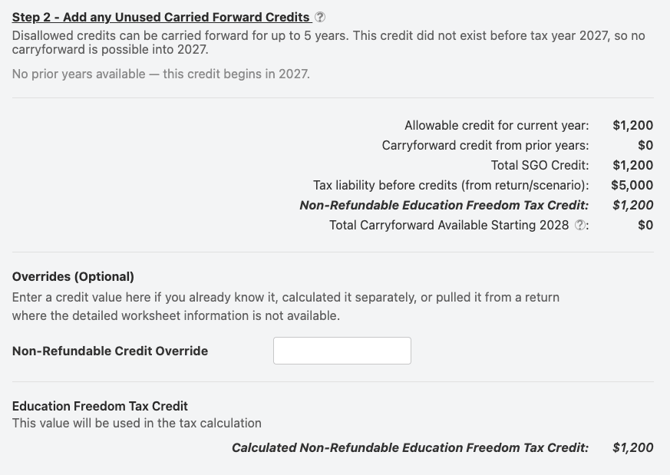
- Enter any eligible unused Education Freedom Tax Credit carryforwards from prior years in the applicable carryforward fields. This credit did not exist before tax year 2027, so no carryforward is possible into 2027.
- Holistiplan will calculate the available current-year credit, apply eligible carryforwards, and determine the allowable nonrefundable credit.
- If the appropriate credit amount has already been determined outside of Holistiplan, use the available override field to enter that amount directly.
Quick overview:
|
First eligible tax year |
2027 |
|
Maximum credit |
$1,700 per taxpayer ($3,400 for MFJ) |
|
Refundable? |
No |
|
Carryforward |
Up to 5 years |
|
Carryforward ordering |
Oldest credit used first |
|
Reduced by state SGO credit? |
Yes, when attributable to the same contribution |
|
Itemizing required? |
No |
|
Can the contribution also be deducted? |
No |
Frequently Asked Questions:
Who can claim the credit?
An individual who is a U.S. citizen or resident may qualify for the credit when:
- The contribution is made in cash to a qualifying SGO.
- The SGO appears on the applicable state's list of approved organizations for the tax year.
- The credit is claimed for the same tax year in which the contribution was made.
Taxpayers do not need to itemize deductions to claim the credit.
How much is the credit?
The credit is generally equal to the taxpayer's qualifying contribution, up to $1,700.
For example:
- A $900 qualifying contribution may generate a $900 credit.
- A $2,500 qualifying contribution is limited to a $1,700 credit before considering any other applicable limitations.
What does this mean for those filing Married Filing Jointly (MFJ)?
-
For taxpayers filing Married Filing Jointly, each spouse is treated as a separate taxpayer and has an individual $1,700 limit.
-
A joint return can therefore qualify for up to $3,400 when each spouse has at least $1,700 of qualified contributions.
-
For example:
- Spouse 1 contributes $1,700 and Spouse 2 contributes $900. The combined credit is $2,600.
- Each spouse contributes at least $1,700. The combined credit is $3,400.
- One spouse contributes $3,400 and the other contributes nothing. The credit is limited to $1,700 because one spouse's excess contribution cannot be used against the other spouse's limit.
Note: The per-spouse treatment is based on proposed Treasury regulations published October 2, 2026. Taxpayers may rely on the proposed regulations for qualifying contributions made on or after January 1, 2027, until final regulations are issued. Holistiplan applies this treatment when calculating the credit.
How do state tax credits affect the federal credit?
-
A taxpayer may also receive a state tax credit for an SGO contribution. When a state credit applies to the same contribution, it reduces the contribution eligible for the federal credit.
-
The state credit is subtracted from the contribution first, and the $1,700 federal limit is then applied to the remaining amount.
-
For Example: A taxpayer makes a $2,000 qualified contribution and receives a $400 state tax credit for the contribution:
-
$2,000 contribution − $400 state credit = $1,600 federal credit
-
-
If the taxpayer instead contributed $3,700 and received a $2,000 state credit, $1,700 would remain and the federal credit would be $1,700.
-
If the taxpayer does not receive a state tax credit for the contribution, no state credit reduction applies.
What happens to unused credit?
-
The Education Freedom Tax Credit is nonrefundable. It can reduce the taxpayer's federal income tax liability to $0, but it cannot create an additional refund.
-
If the taxpayer cannot use the full available credit in the current year, the unused amount may be carried forward for up to five years.
-
Carry-forwards are applied on a first-in, first-out (FIFO) basis, meaning the oldest available credit is used first.
- Because carryforwards can accumulate, the total credit used in a future year may exceed $1,700. The $1,700 limit applies to the credit generated by a taxpayer's current-year contributions, not to the total credit available after including carryforwards.
-
Any credit remaining after its five-year carryforward period expires and can no longer be used.
How does the credit interact with other tax credits?
The amount of Education Freedom Tax Credit that can be used in a given year depends on the taxpayer's remaining tax liability after certain other nonrefundable credits are applied.
These may include:
- Foreign Tax Credit
- Child Tax Credit and credit for other dependents
- Child and Dependent Care credit
- Education credits
- Credit for the elderly or disabled
- Mortgage interest credit
If these credits reduce the applicable tax liability to $0, the taxpayer may not be able to use the Education Freedom Tax Credit in the current year. Any eligible unused amount may still be carried forward.
Can taxpayers deduct the contribution?
-
No. A contribution used to claim the Education Freedom Tax Credit cannot also be claimed as a federal charitable contribution deduction.
-
The same contribution cannot generate both a charitable deduction and the Education Freedom Tax Credit.
Note: This article reflects Holistiplan's current implementation based on available statutory and regulatory guidance. Additional guidance may affect how the Education Freedom Tax Credit is calculated or applied.