![Holistiplan Logo (800x200 px).webp]](https://help.holistiplan.com/hs-fs/hubfs/Holistiplan%20Logo%20(800x200%20px).webp?width=160&height=40&name=Holistiplan%20Logo%20(800x200%20px).webp)
When taking deductions for depreciation on a property, you must recapture that depreciation as Section 1250 gains on Schedule D when selling that property. The most common scenario where this happens is when a rental property is sold that has been reporting business income on Schedule E, and depreciation expenses have also been deducted from that property's income.
The sale of the property is reported on Form 4797, but the tax implications from that sale will largely play out on Schedule D.
While Form 4797 reports the sale of business property, only the short-term gains subject to ordinary income flow through to the Other gains (or losses) line item related to Form 4797 on Schedule 1. Gains subject to long-term capital gains treatment are reported on Schedule D.
To report a gain with depreciation recapture
-
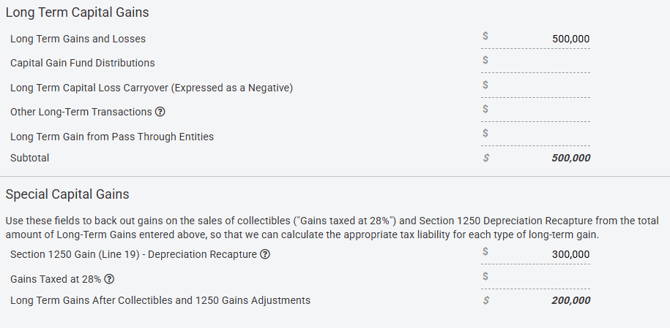
Enter any long-term gain, including any amount of Section 1250 gains in the long-term capital gains field in the Schedule D Income section and Section 1250 gain in the Section 1250 Gain field.
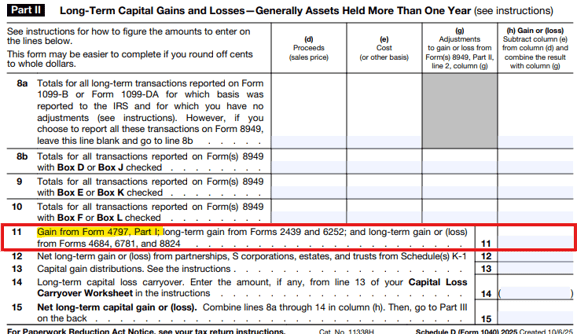
One of the more common mistakes is to not include this Section 1250 gain in the long-term gain, for fear of being double-counted. However, the instructions for line 11 of Schedule D direct us to include the long-term gains reported on Part I of Form 4797, and line 11 is included in the total net long-term gains reported on line 15 of Schedule D.
For example, let's say our clients sold a rental property for a net long-term gain of $500,000. While reporting that rental income on Schedule E over the years, they also deducted $300,000 in depreciation on that rental property. To accurately model that sale, we would want to enter the full $500,000 (not $200,000) in the Long Term Gains and Losses field in the Long-Term Gains modal, and $300,000 in the Section 1250 Gain (Line 19) - Depreciation Recapture field.