![Holistiplan Logo (800x200 px).webp]](https://help.holistiplan.com/hs-fs/hubfs/Holistiplan%20Logo%20(800x200%20px).webp?width=160&height=40&name=Holistiplan%20Logo%20(800x200%20px).webp)
Real estate owners have the ability to perform an exchange for “like” property rather than sell their property. Doing so defers taxation of any gains until the newly acquired property is sold, including both long-term capital gains and depreciation recapture. This technique is known as a 1031 exchange, and provided it is performed properly, can yield significant tax deferral opportunities for property owners.
While this article covers how to illustrate the possible tax savings of a 1031 exchange, please note that these exchanges can be complicated and, if done incorrectly, can result in unexpected taxation for the taxpayer. Users who are interested in this strategy should consult with a professional tax professional to make sure they understand the rules involved.
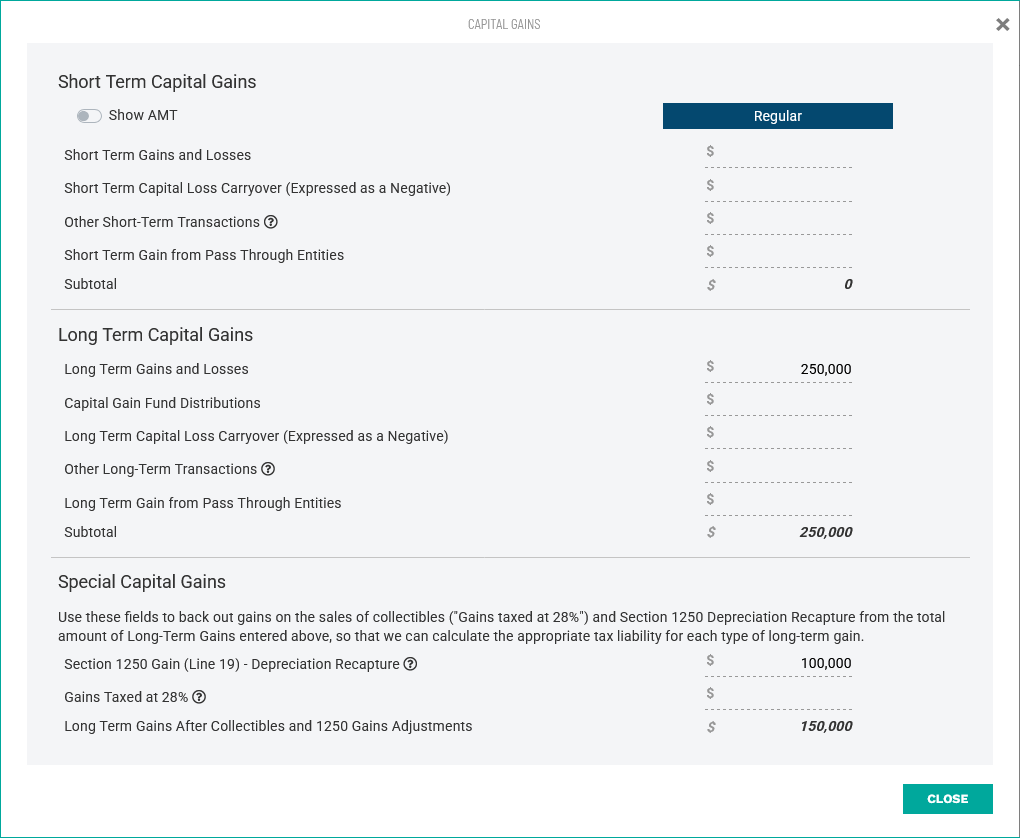
In this example, we will assume that the taxpayer is a member of a household that files Married Filing Jointly, with both members of the household being over age 65 and taking the standard deduction. Taxpayer 1 owns a real estate rental property with an adjusted cost basis of $250,000, reflecting an original purchase price of $350,000 and $100,000 of depreciation. The property is now valued at $500,000, and the taxpayer has owned the property for five years, making it eligible for long-term capital gains. For the sake of this exercise, this is the only income the couple will realize.
To model a sale of this property, users would enter the appropriate information for gains and depreciation in the Schedule D/capital gains modal:
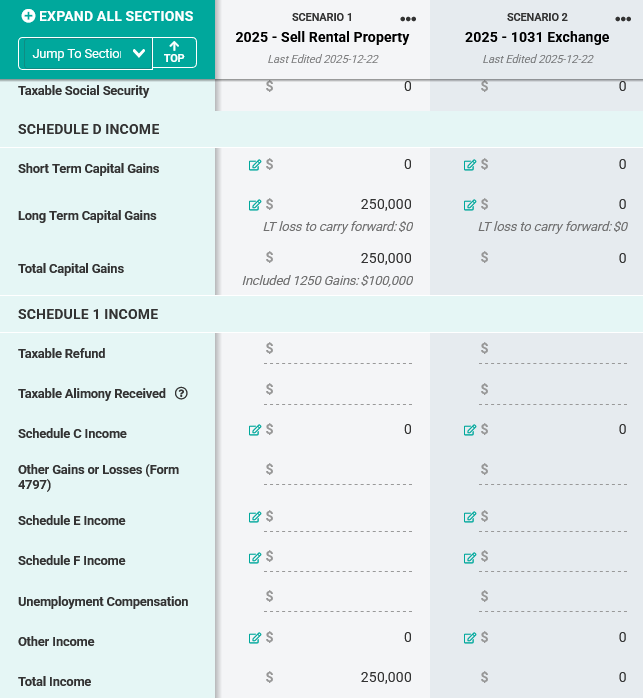
To illustrate a 1031 exchange, create a copy of this scenario, and then delete the information on the Schedule D/capital gains modal. Our new scenario now has no income:
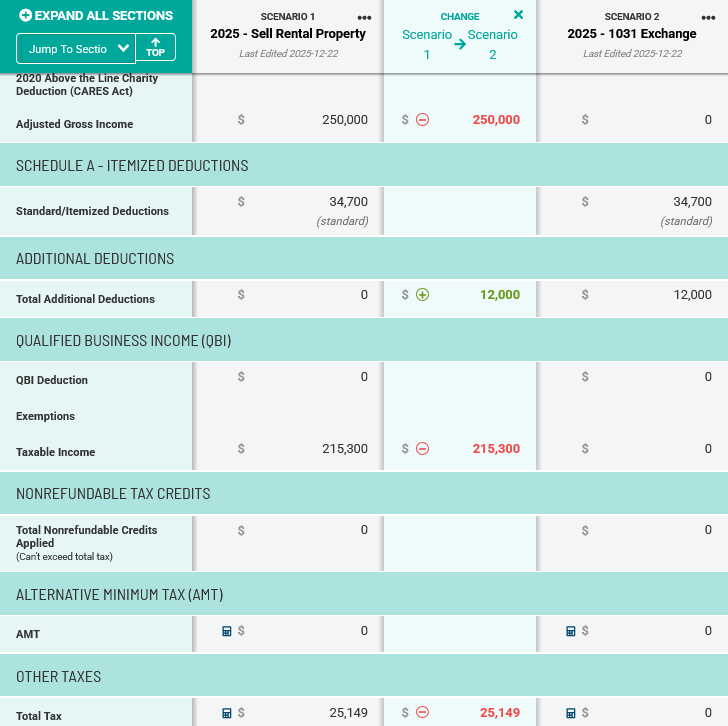
To illustrate the tax savings, use the Scenario Comparison tool and focus on the Total Tax differential between the two scenarios (note because this is a 2025 scenario and both members of the household are over age 65, in Scenario 2, the taxpayers are each eligible for the full Enhanced Senior Deduction. In Scenario 1, income is high enough that both members are phased out of this deduction:
Note that unlike a sale, a 1031 exchange is not considered a full disposition of a passive activity, and therefore does not result in the ability for taxpayers to realize previously disallowed passive losses on Schedule E.