![Holistiplan Logo (800x200 px).webp]](https://help.holistiplan.com/hs-fs/hubfs/Holistiplan%20Logo%20(800x200%20px).webp?width=160&height=40&name=Holistiplan%20Logo%20(800x200%20px).webp)
Charitable Giving - Itemized Deductions
Use the Schedule A - Itemized Deductions section of Scenario Analysis to model deductible charitable giving, both for taxpayers who itemize their deductions and for taxpayers claiming the charitable deduction for non-itemizers (as part of the 2025 tax legislation).
To access the Charity Worksheet, navigate to the Schedule A- Itemized Deduction section and click the pencil icon (circled below) in the Charity row. 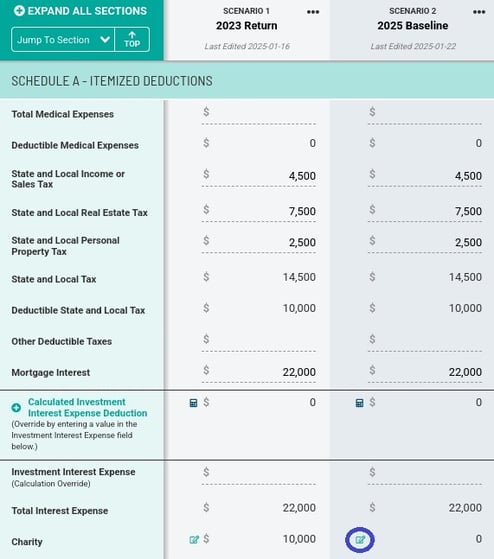
This brings up the Charity Worksheet.
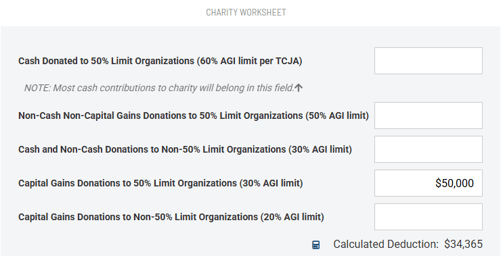
Note that the worksheet contains multiple entries based on the nature of the gifted asset and the type of the recipient organization, both of which factor into how much of a charitable gift is deductible (based on Adjusted Gross Income; AGI).
Types of Charitable Contributions
Charitable contributions are categorized based on the type of asset donated.
| Contribution Type | Description | Typical AGI Deduction Limit |
|---|---|---|
| Cash contributions | Cash, checks, credit card, or electronic donations | Up to 60% of AGI for most public charities |
| Non-cash property | Tangible property such as equipment, vehicles, or artwork | Typically 30% of AGI |
| Appreciated securities | Long-term capital gain assets such as stocks or mutual funds | Typically 30% of AGI |
Types of Recipient Charities
Deduction limits also depend on the type of organization receiving the contribution.
| Charity Type | Description |
|---|---|
| 50% limit organizations (public charities) | Churches, schools, hospitals, public charities |
| Non-50% limit organizations | Private foundations and certain trusts |
The IRS offers a tax-exempt organization search tool with corresponding codes if you are unsure if a particular charity is a 50% or non-50% organization. Enter the charitable contribution in the appropriate field.
Donor Advised Funds (DAFs), by definition, are 50% limit organizations. Therefore, contributions to a DAF will be entered in one of the 50% limit organization fields, depending on the nature of the asset(s) being gifted.
Holistiplan will automatically calculate the deductible amount of any entered gift and apply any appropriate AGI-related limitations.
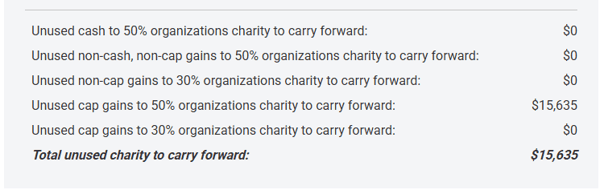
If a taxpayer is unable to deduct their full charitable contribution, Holistiplan calculates the amount of any charitable deduction that gets carried forward to the next tax year. Taxpayers can carry forward previously unused charitable deductions for 5 years.
In the example above, 30% of the taxpayer's AGI came out to $34,365, which was the limit of their charitable deduction. The taxpayer can use the $15,635 charitable carryforward in the next tax year.
Charitable Carryforwards
Because scenarios are not linearly linked, Holistiplan does not automatically populate the amount of charitable carryforwards in subsequent scenarios. Users should include the amounts of any charitable carryforwards along with any new charitable gifts in a future year.
For example, assume that in the year following the example above, the same taxpayer made another gift of $30,000 of appreciated securities ("cap gains") to a public charity. To model this, combine the $15,635 charitable carryforward from the previous year with the $30,000 current gift to arrive at a total amount of $45,635. Then enter that amount in the "Capital Gains Donations to 50% Limit Organizations (30% AGI limit)" in the current year's Charity Worksheet.
To keep track of charitable carryforwards from specific years (remember, they can only be carried forward 5 years), organizing those carryovers by tax year using our Calculation Rows feature in Field Notes is a helpful way to track carryovers from multiple years.
Charitable Giving for Non-Itemizers (OBBBA)
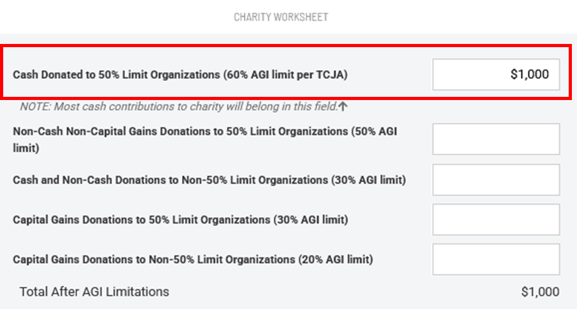
Starting in 2026, taxpayers who take the standard deduction can still take a charitable gifting deduction. To model this, follow the same procedure as outlined above (even though the taxpayer is going to take the standard deduction). Only use the top row of the Charity Worksheet, as this deduction is only available for cash gifts. Holistiplan will detect that the taxpayer is taking the standard deduction and generate the charitable deduction for non-itemizers in the Additional Deductions Section.

Qualified Charitable Distributions (QCDs)
Taxpayers who are over age 70.5 can direct charitable contributions to go directly from their IRAs to a recipient charity. Those taxpayers do not get a corresponding charitable deduction on Schedule A, but QCDs are excluded from taxable income.
Click here for detailed instructions on how to model QCDs in Scenario Analysis.