![Holistiplan Logo (800x200 px).webp]](https://help.holistiplan.com/hs-fs/hubfs/Holistiplan%20Logo%20(800x200%20px).webp?width=160&height=40&name=Holistiplan%20Logo%20(800x200%20px).webp)
Jump to:
- Medical Expenses
- State and Local Taxes (SALT)
- Mortgage/Investment Interest
- Charitable Contributions
- Casualty/Theft/Other Deductions
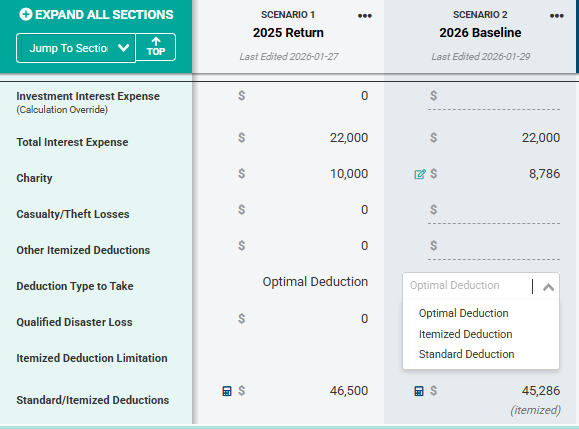
- Deduction Type to Take / Optimal Deduction
Don't worry about hand-calculating AGI limitations for medical expenses or charity, or the cap on deductible state and local taxes (SALT). Simply enter the gross amounts, and Holistiplan will calculate how much will be deductible. For more information on how Schedule A works and is calculated, check out the Instructions for Schedule A from the IRS.
More information regarding the passage of OBBBA and its impact on your clients' itemized deductions, including changes to the SALT and charitable deductions, is here.
- Medical Expenses: Enter the gross amount of total medical expenses. Holistiplan will incorporate the Adjusted Gross Income (AGI) and deduct only the amount of expenses that exceed the 7.5% AGI floor.
- State and Local Taxes (SALT): Enter any state and local income taxes or sales taxes, state and local real estate taxes, and any state and local personal property taxes. Holistiplan will take into account the statutory caps on the deductible portion of SALT entries and apply any phaseouts to those caps based on income.
Holistiplan does not automatically pull information from the state tax projections up to the "Schedule A - Itemized Deductions" section, and those deductions for SALT in Schedule A must be manually entered for two reasons.
- The SALT deductions are for taxes "paid," not taxes "due," as noted in the line 5a Instructions for Schedule A. Because of that, the taxes owed are not what generate that deduction, but rather the amount of state income taxes withheld or otherwise paid throughout the tax year.
- Some states allow you to elect to deduct sales taxes instead of income taxes, particularly those states without a state income tax. Because that option exists for many states, we cannot simply assume the state income tax was chosen.
- Mortgage/Investment Interest: Enter the deductible portion of mortgage interest or calculate the investment interest expense deductible. Limits on the deductible portion of mortgage interest cannot be calculated in Holistiplan due to the factors impacting those limits, including the origination date of the mortgage and filing status, among others, as noted in Figure A of IRS Publication 936.
- Charitable Contributions: Use the Charity Worksheet within the Schedule A section of Scenario Analysis to model cash, capital gains, or non-cash/non-capital gains deductions to charity. More details on how to model charitable deductions can be found in our article, linked here.
- Casualty/Theft/Other Deductions: Enter any other deductions for casualty, theft, qualified disaster losses, or other itemized deductions. More information on the rules around losses due to casualty, theft, or from a qualified disaster can be found on Form 4684.
When copying a return or scenario, a best practice is to review the deductions that are copied over to verify that they will apply in the modeled tax year.
For example, Peter and Paula made a $10,000 charitable contribution in 2025, as shown below in Scenario 1. When copying the return, this charitable contribution copies into the new scenario, which is our baseline for 2026. (Note that due to the new 0.5% AGI charitable floor limitation for itemizers, their calculated charitable deduction is $8,786). If they are donating a different amount, or not at all, this would require an update in the Charity Worksheet.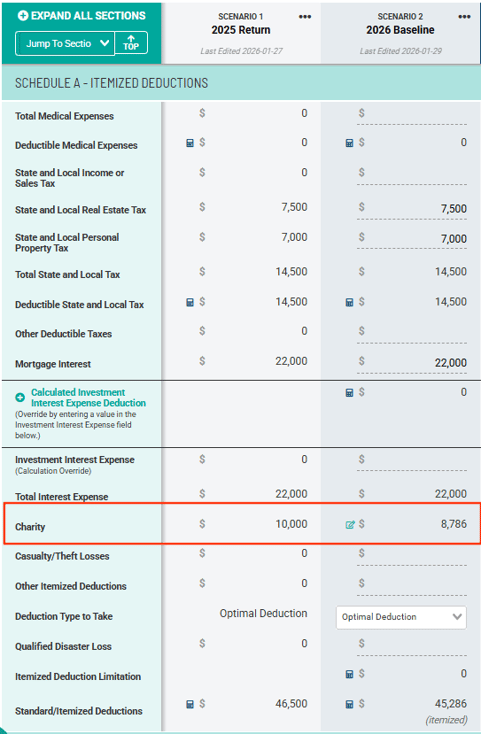
What does the Optimal Deduction Mean?
Holistiplan defaults to the Optimal Deduction. This means taking the deduction that results in the lowest overall tax, which does not necessarily mean the optimal deduction is the higher of the standard deduction or the total itemized deductions.
When would the optimal deduction be the lesser of the standard or itemized deduction?
When AMT (Alternative Minimum Tax) is involved, the preference item on line 2a of Form 6251, where AMT is calculated, can be either the total standard deduction or the amount of taxes deducted (SALT). Because the difference between itemizing or taking the standard deduction can affect the amount of AMT due, it may be more advantageous, from a total tax perspective, to pay more in regular tax (line 16 of Form 1040) if it reduces the AMT otherwise due (based on the deduction method elected). For that reason, the optimal deduction may be the lower deduction, but Holistiplan will do that analysis for you if the "Optimal Deduction" type is chosen.
To force a deduction type, select Itemized or Standard Deduction from the dropdown.